How to Lower Your Electric Bill Without Replacing Major Appliances
Reading time: 12 minutes
Here’s a number that might sting: the average American household spent $1,784 on electricity in 2025, according to the U.S. Energy Information Administration — and with utility rates climbing another 4.2% in early 2026, that figure is only heading north. The instinctive response? Replace the old refrigerator, upgrade to an energy-star washer, rip out the water heater. But hold on. What if you could slash your bill by 20–35% without touching a single major appliance?
That’s not a sales pitch — it’s a strategy. And it’s exactly what we’re going to map out together.
This guide is for the practical homeowner who doesn’t have $5,000 to spend on new appliances but absolutely has the time and willingness to make smart behavioral and low-cost infrastructure changes. Think of it as your tactical energy audit — no electrician required for most of it.
Table of Contents
- Why Appliances Aren’t the Whole Story
- The Phantom Drain Problem: Standby Power
- Heating and Cooling Without a New HVAC
- Smart Usage Habits That Move the Needle
- Lighting and Low-Cost Upgrades
- Time-of-Use Billing: The Hidden Rate Hack
- Energy-Saving Strategy Comparison
- Real-World Results: Two Case Studies
- Frequently Asked Questions
- Your Power Bill Action Plan: Starting This Week
Why Appliances Aren’t the Whole Story
It’s tempting to point the finger at the old chest freezer humming in the garage, but the truth is more nuanced. Major appliances — refrigerators, washers, dryers, dishwashers, ovens — collectively account for roughly 35–40% of household electricity consumption. That means the other 60–65% is driven by lighting, electronics, HVAC behavior, water heating habits, and those sneaky vampire loads.
In other words, the house itself — and how you use it — is the bigger story.
Think of it this way: if your refrigerator is consuming 500 kWh per year, upgrading to a newer model might save you 100–150 kWh, translating to roughly $15–$20 in annual savings. Meanwhile, adjusting your thermostat schedule, sealing air leaks, and eliminating standby power loads could realistically save you 400–800 kWh — or $60–$120 — without spending more than $50 in materials. The math speaks clearly.
“Most homeowners are leaving significant savings on the table every month, not because of old appliances, but because of how the home is operated. Behavior and low-cost fixes routinely outperform appliance upgrades in the short term.” — Dr. Karen Ehrhardt-Martinez, behavioral energy researcher at the American Council for an Energy-Efficient Economy (ACEEE)
The Phantom Drain Problem: Standby Power
What Is Vampire Power and How Much Is It Costing You?
Every device that has a clock, remote receiver, or instant-on feature draws power even when you think it’s “off.” This phenomenon — called standby power or vampire load — accounts for an estimated 5–10% of the average household’s electricity bill. According to Lawrence Berkeley National Laboratory’s 2025 residential energy report, the average U.S. home has approximately 40 devices continuously drawing standby power.
Common culprits include:
- Cable boxes and streaming devices — often the worst offenders, drawing 15–30 watts continuously
- Gaming consoles — a PlayStation or Xbox in standby can use 1–8 watts depending on the model
- Microwave ovens — the clock display alone draws 2–7 watts, 24/7
- Phone and laptop chargers — even when nothing is plugged in, a charger in a socket draws 0.1–0.5 watts
- Smart TVs — many 2024–2026 smart TVs draw 0.5–3 watts in standby mode
The Smart Power Strip Solution
The most effective countermeasure is deceptively simple: smart power strips. These $25–$45 devices cut power to peripheral outlets when the “master” device (say, your television) is turned off. So the moment you switch off the TV, the strip automatically cuts power to the cable box, gaming console, soundbar, and streaming stick all at once.
For areas where you can’t use a smart strip — like entertainment centers that are always in use — consider individual smart plugs paired with a scheduling app. Set them to cut power between midnight and 6 AM, and you’ll eliminate 6 hours of phantom drain daily without changing any behavior.
Quick estimate: If you eliminate phantom loads averaging 100 watts across your home — a conservative figure — you save 2.4 kWh per day, or roughly 876 kWh annually. At the 2026 national average rate of $0.155 per kWh, that’s $135.78 saved per year for a one-time investment of under $80 in smart strips.
Heating and Cooling Without a New HVAC
Heating and cooling typically represent 43–48% of a home’s total energy consumption — by far the largest single category. Before you even think about replacing a functioning furnace or air conditioner, consider that most HVAC inefficiency is operational, not mechanical.
Thermostat Strategy: The 7-8 Degree Rule
The U.S. Department of Energy has consistently cited its “7-8 degree rule”: adjusting your thermostat 7–8°F lower (in winter) or higher (in summer) for 8 hours per day can save up to 10% annually on heating and cooling costs. If your current HVAC spend is $850/year, that’s $85 back in your pocket — just from temperature scheduling.
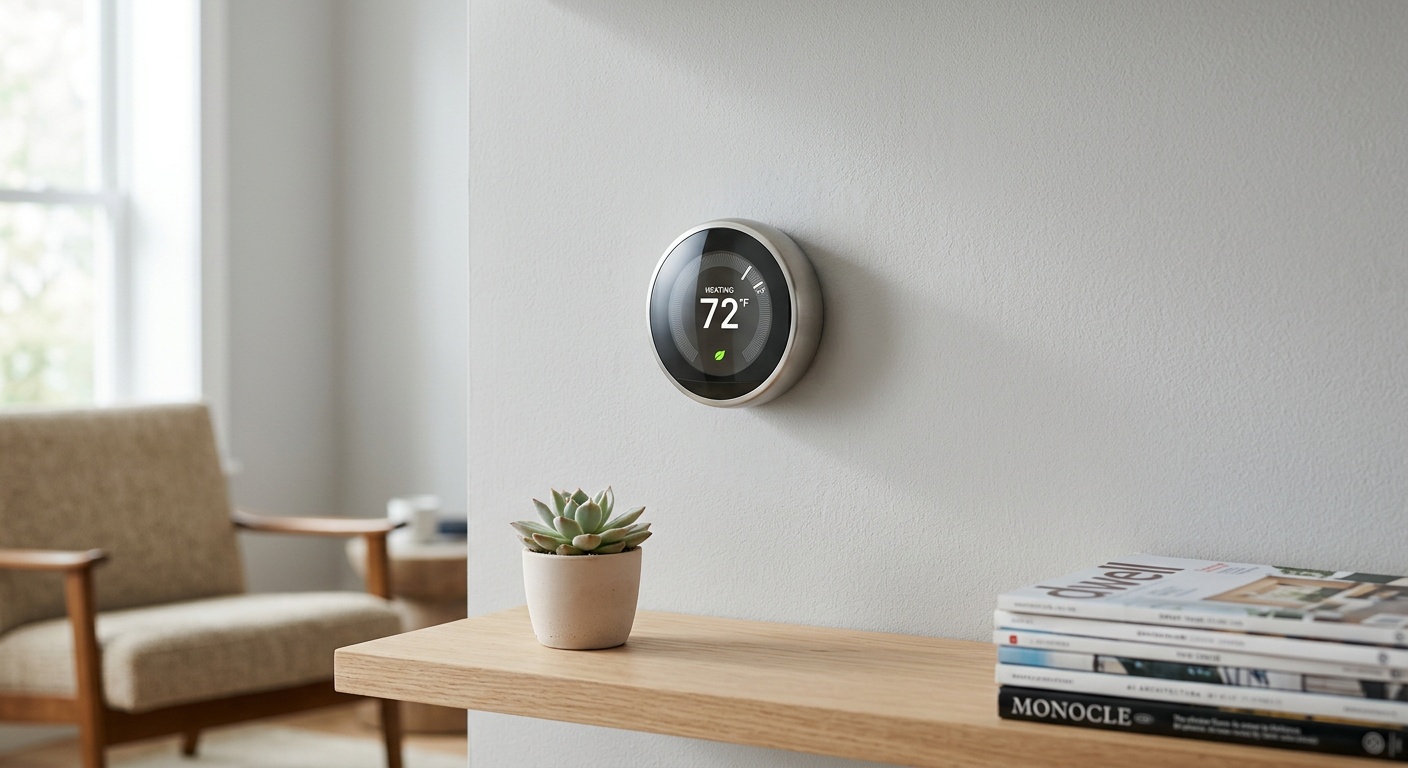
If you don’t have a programmable thermostat, a basic digital one costs $25–$35 at any hardware store and takes 20 minutes to install. A Wi-Fi-enabled smart thermostat like the Google Nest or Ecobee runs $130–$180 but can save an average of $145–$170 per year, according to Ecobee’s 2025 energy data report from over 4 million connected homes.
Air Sealing: The Invisible Leak
Your HVAC system might be working perfectly — but if your home has air leaks, you’re essentially conditioning the outdoors. The typical American home loses 20–30% of conditioned air through gaps around windows, door frames, electrical outlets, attic hatches, and plumbing penetrations.
The fix is inexpensive and satisfying:
- Weatherstripping for doors: $10–$25 per door, takes 30 minutes
- Caulk around window frames and baseboards: $5 per tube, one tube covers most of a room
- Foam gaskets behind electrical outlet plates on exterior walls: $5 for a pack of 10
- Draft snakes at the base of exterior doors: $8–$15 each, or DIY with a rolled towel
Total investment for a medium-sized home: $60–$120. Potential annual savings: $150–$300, depending on climate and current leakage. That’s a payback period measured in weeks, not years.
Pro Tip: On a windy day, hold a lit incense stick near window edges, outlet plates, and door frames. Smoke movement reveals air infiltration with pinpoint accuracy — no professional audit required.
Smart Usage Habits That Move the Needle
This section is where behavioral economics meets your electricity meter. Small, consistent changes in how you operate existing appliances — not which appliances you own — can produce meaningful monthly savings.
Water Heater Optimization
Most water heaters are set to 140°F at the factory. The EPA recommends 120°F as safe and sufficient for most households. Lowering the temperature from 140°F to 120°F reduces water heating energy use by 6–10% and also slows mineral buildup in the tank. This takes 60 seconds with a flathead screwdriver.
Washer and Dryer Habits
Your washing machine is already installed — let’s just use it smarter. Switching from hot-water washes to cold water on every load can reduce washing machine energy use by up to 90% (since heating water is the dominant energy cost). Modern detergents in 2026 are formulated to work excellently in cold water, so laundry quality is unaffected.
For the dryer: always clean the lint trap before each cycle (a clogged trap increases drying time by 15–20%), and consider air-drying clothes during warm months. A $12 drying rack pays for itself in the first week of use during summer.
Refrigerator Habits Without Replacement
- Keep the refrigerator at 35–38°F and the freezer at 0°F — colder settings waste energy with no food safety benefit
- Allow hot food to cool before refrigerating — placing hot dishes inside forces the compressor to work harder
- Check door seals by closing a dollar bill in the door; if it slides out easily, the gasket needs replacing (a $20–$40 fix)
- Keep the coils on the back or bottom clean — dusty coils reduce efficiency by up to 25%
Lighting and Low-Cost Upgrades
If you’re still using incandescent bulbs anywhere in your home in 2026, this is your most immediate win. LED bulbs use 75–80% less energy than incandescents and last 15–25 times longer. A 60-watt incandescent replaced by a 9-watt LED saves approximately $7–$10 per year, per bulb in a typical household.
With an average of 30–45 light fixtures in a home, full LED conversion can save $150–$300 annually — and the bulbs themselves cost $2–$5 each in 2026. This is one of the highest ROI moves available, period.
Additional lighting tips:
- Install occupancy sensors in bathrooms, laundry rooms, and garages — spaces often lit for hours with no one in them ($15–$25 per sensor)
- Use dimmer switches wherever possible; dimming a light to 75% intensity uses roughly 20% less power
- Maximize natural light during daytime by keeping window coverings open — free light is the best light
Time-of-Use Billing: The Hidden Rate Hack
This is one of the most underutilized strategies available to homeowners in 2026, and it costs absolutely nothing to implement — once you understand it.
Many utilities across the U.S. now offer Time-of-Use (TOU) rate plans, where the cost of electricity varies depending on when you use it. Peak hours (typically 4 PM–9 PM on weekdays) carry rates 2–4 times higher than off-peak hours (late night, early morning, and weekends).
Under a typical TOU structure in 2026:
- Peak rate: $0.35–$0.45 per kWh
- Off-peak rate: $0.08–$0.12 per kWh
By shifting energy-intensive activities — running the dishwasher, doing laundry, charging electric vehicles — to off-peak hours, households report saving $200–$400 annually without changing a single appliance. Check with your local utility or their website to see if TOU plans are available in your area; most major utilities in California, Texas, New York, and Illinois have robust TOU offerings as of 2026.
Quick Scenario: Imagine you run your dishwasher every evening at 6:30 PM — right in the peak window. Each cycle uses approximately 1.5 kWh. At peak rates ($0.40/kWh), that’s $0.60 per cycle, or $219 per year. Move that exact same cycle to 10 PM at off-peak rates ($0.10/kWh), and your annual cost drops to $54.75. Same dishwasher. Same dirty dishes. $164 in annual savings from a scheduling change alone.
Energy-Saving Strategy Comparison
Here’s how these strategies stack up against each other in terms of cost, effort, and annual savings potential:
| Strategy | Upfront Cost | Annual Savings | Effort Level | Payback Period |
|---|---|---|---|---|
| Smart power strips + standby elimination | $50–$80 | $100–$150 | Low | 4–8 months |
| Air sealing (weatherstripping + caulk) | $60–$120 | $150–$300 | Medium | 3–6 months |
| Full LED lighting conversion | $60–$150 | $150–$300 | Low | 3–6 months |
| Time-of-Use rate shifting | $0 | $150–$400 | Low | Immediate |
| Smart thermostat + scheduling | $25–$180 | $85–$175 | Low–Medium | 1–12 months |
Annual Savings Potential by Strategy
Real-World Results: Two Case Studies
Case Study 1: The Garcia Family, Phoenix, Arizona
The Garcia household — two adults, two teenagers, a 1,980 sq ft home built in 1998 — was paying an average of $218/month on electricity in the summer of 2025, primarily due to heavy air conditioning usage. Rather than replacing their 9-year-old central HVAC system (quoted at $7,200 for replacement), they committed to a no-appliance-replacement approach.
Their strategy over three months:
- Enrolled in APS (Arizona Public Service) Time-of-Use plan and shifted laundry and dishwasher to 9 PM or later
- Installed a Google Nest thermostat and programmed it to 78°F during the day (while at work) and 74°F evenings
- Sealed all exterior-facing window frames and door weatherstripping — found 11 significant air gaps
- Added insulating cellular blinds to south and west-facing windows
- Replaced all remaining incandescent bulbs (14 bulbs) with LEDs
Result: Average summer bill dropped from $218 to $141/month — a reduction of $77/month, or $924/year. Total investment: $312. Full payback in under four months.
Case Study 2: Marcus T., Chicago, Illinois — Single-Person Apartment
Marcus lived in a 750 sq ft apartment in Chicago’s Logan Square neighborhood, paying roughly $94/month in 2025. His landlord controlled the central HVAC, meaning he had zero control over the heating system — but he still wanted to cut costs.
His limited-control approach:
- Identified 7 devices drawing vampire loads using a $22 Kill-A-Watt meter; eliminated them with smart plugs
- Replaced 8 incandescent bulbs in fixtures with LEDs
- Switched all laundry to cold water cycles and moved loads to 10 PM (ComEd’s off-peak window)
- Unplugged the second mini-fridge he rarely used
- Added a $14 door draft stopper to his apartment’s entry door
Result: Monthly bill dropped from $94 to $67/month — saving $324 annually on a total investment of under $80. A return of over 400% in the first year.
Frequently Asked Questions
How much can I realistically save without replacing any appliances?
Based on data from the ACEEE and real-world case studies in 2025–2026, most households can realistically achieve 15–30% reductions in their electricity bill through behavioral changes, low-cost sealing, lighting upgrades, and rate plan optimization alone. For the average household paying $1,784/year, that’s $267–$535 in annual savings — often achieved with a total investment of $100–$300. Results vary based on climate, home size, current habits, and utility rate structure, but the floor-level savings from TOU shifting and LED conversion alone are consistently significant.
What’s the single highest-impact change I can make today for free?
Enroll in a Time-of-Use rate plan with your utility — if available in your area — and shift your high-draw activities (dishwasher, washing machine, clothes dryer, EV charging) to after 9 PM. This costs nothing, requires no purchases, and can save $150–$400 per year depending on your current energy usage and local TOU rate differential. If TOU isn’t available, the next best free action is lowering your water heater temperature from 140°F to 120°F, which takes under two minutes and saves 6–10% on water heating costs immediately.
Are smart home devices worth the upfront cost for energy savings?
For most households in 2026, the answer is a qualified yes — with the emphasis on “qualified.” A $160 smart thermostat with a $145–$170 average annual savings offers an excellent ROI if you’ll be in the home for 2+ years. Smart power strips at $25–$45 each pay back in 3–6 months. However, elaborate whole-home automation systems costing $500–$2,000+ rarely offer proportionally better returns than simple, targeted solutions. The principle: buy smart devices where they directly control high-draw systems (HVAC, entertainment centers, laundry), and skip them for low-draw applications where manual habit changes achieve the same result for free.
Your Power Bill Action Plan: Starting This Week
The broader trend is clear: electricity prices in the U.S. are projected to rise an additional 3–5% annually through 2028, driven by grid infrastructure investment, increased demand from EV adoption, and data center expansion. Every efficiency improvement you make today compounds in value as rates climb. This isn’t just about saving money now — it’s about future-proofing your household budget.
Here’s your pragmatic, week-by-week roadmap to get started:
- Week 1 — Audit and enroll: Call or log into your utility’s website and check for Time-of-Use plans. Enroll if available. Walk through your home identifying devices on standby 24/7.
- Week 2 — Plug the leaks: Do the incense smoke test around windows, doors, and outlets. Purchase weatherstripping and caulk. Seal every gap you find. This is the highest ROI afternoon you’ll spend all year.
- Week 3 — Light and power: Replace remaining non-LED bulbs. Install 2–3 smart power strips on your highest-load entertainment and office setups. Consider one smart plug for your router/modem setup to schedule nightly off periods.
- Week 4 — Thermostat and water: Install or program a thermostat schedule. Lower your water heater to 120°F. Clean your refrigerator coils. Switch all laundry permanently to cold water.
- Month 2 — Review and optimize: Compare your first full optimized bill to the previous month. Calculate your actual savings. Identify any remaining gaps and decide whether a smart thermostat upgrade makes financial sense for your specific situation.
Key takeaways to carry with you:
- 60–65% of your electricity bill has nothing to do with major appliances
- Standby power, air leaks, incandescent lighting, and peak-hour usage are the real culprits
- The most powerful money-saving change — TOU rate shifting — costs exactly nothing
- Total investment of $100–$300 can realistically return $300–$800 annually
- Consistent small actions compound into significant annual savings
Here’s the question worth sitting with: If you could put an extra $400–$900 back into your budget every year simply by changing when and how you use power — not what power you own — what would you do with that money?
The tools are already in your hands. The savings are already in your home. They’re just waiting for you to claim them.