Circuit Breaker vs GFCI Outlets: When Each Protects Your Home
Reading time: 12 minutes
Here’s a scenario that plays out in thousands of homes every year: A homeowner notices the lights flickering near the bathroom sink, shrugs it off, and moves on. Months later, an electrician discovers severe wiring damage behind the wall — damage that a properly installed GFCI outlet could have flagged in seconds. Meanwhile, that same home’s circuit breaker is doing its job perfectly well, protecting against overloads in the main panel — but it was never designed to catch the ground fault quietly developing near the water.
Sound familiar? If you’ve ever wondered why your home has both circuit breakers and GFCI outlets — and whether one makes the other redundant — you’re asking exactly the right question. The answer, it turns out, is nuanced, practical, and genuinely important for your family’s safety.
As of 2026, electrical fires remain one of the leading causes of residential property damage in the United States, with the U.S. Fire Administration reporting approximately 46,700 home electrical fires annually, resulting in over $1.5 billion in property losses. Understanding the distinct roles of circuit breakers and GFCI protection isn’t just electrician trivia — it’s foundational home safety knowledge.
Table of Contents
- How They Work: The Core Difference
- Circuit Breakers: Your Overload Guardian
- GFCI Outlets: The Ground Fault Sentinel
- Side-by-Side Comparison
- When Each Type Protects You
- Common Challenges Homeowners Face
- Protection Coverage by Area
- Frequently Asked Questions
- Your Home Safety Action Plan
How They Work: The Core Difference
Think of your home’s electrical protection system like a layered security network. Circuit breakers and GFCI outlets aren’t competitors — they’re specialized responders to completely different types of electrical hazards. Confusing their roles is like asking why a smoke detector doesn’t also stop a burglar. Each tool is engineered for a specific threat.
Circuit breakers respond to excessive current — too much electricity flowing through a wire, which generates heat and can ignite surrounding materials. GFCI outlets, by contrast, respond to current imbalance — electricity that’s leaking out of the intended circuit pathway, often through a person’s body or water.
The distinction matters enormously because these two hazards require fundamentally different detection thresholds. A circuit breaker might only trip when current reaches 15 or 20 amperes. A GFCI outlet trips when it detects an imbalance as small as 4 to 6 milliamperes — roughly 1/3,000th of the current needed to trip a standard breaker. That’s a critical gap in protection that explains exactly why both systems are required by the National Electrical Code (NEC).
Circuit Breakers: Your Overload Guardian
What a Circuit Breaker Actually Does
Your electrical panel — that gray metal box in the basement, utility room, or garage — houses a series of circuit breakers, each governing a specific circuit in your home. When the current flowing through that circuit exceeds its rated capacity (typically 15 or 20 amps for standard residential circuits), the breaker’s internal bimetal strip or electromagnet triggers a mechanical switch, physically interrupting the flow of electricity.
This protects against two primary threats:
- Overloads: Too many devices drawing power simultaneously on one circuit (running a space heater, microwave, and hair dryer from the same circuit, for example)
- Short circuits: A direct connection between the hot and neutral wires, causing a massive, instantaneous surge in current
Modern homes built after 2015 increasingly use arc-fault circuit interrupters (AFCIs) alongside standard breakers. AFCIs detect the specific electrical signature of arcing — sparks jumping between damaged wire conductors — which is the leading cause of electrical fires. In 2026, the NEC requires AFCI protection in virtually every living space of new residential construction, including bedrooms, living rooms, kitchens, and hallways.
Real-World Example: The Overloaded Holiday Circuit
Consider this common holiday scenario: A family in Columbus, Ohio, decorates their 1998-built home with extensive indoor and outdoor lighting. They plug multiple light strings, an inflatable display motor, and a heated blanket into a single living room circuit. At around 2 AM, the circuit breaker trips — plunging half the house into darkness. Frustrating? Yes. But the breaker worked exactly as designed. Without it, the overheated wiring inside the wall could have sparked a fire while everyone slept.
The circuit breaker, in this case, detected nothing unusual about the type of current — only its quantity. It has no mechanism for detecting whether that current is safely contained within the circuit or leaking outward. That’s where GFCI technology takes over.
GFCI Outlets: The Ground Fault Sentinel
The Physics Behind Ground Fault Protection
GFCI stands for Ground Fault Circuit Interrupter. These outlets — identifiable by the small “TEST” and “RESET” buttons on their face — contain a sophisticated monitoring circuit that continuously compares the current flowing out through the hot wire to the current returning through the neutral wire. Under normal operation, these values are equal. The moment they diverge by as little as 4–6 milliamperes, the GFCI’s internal relay opens in approximately 1/40th of a second, cutting power.
Why does this matter so profoundly? Because a ground fault — electricity taking an unintended path to ground — is precisely what happens when a person is being electrocuted. The current leaving through the hot wire is finding its way back through a human body rather than the neutral conductor. A standard circuit breaker would never detect this because the total current draw doesn’t change enough to trigger it. The GFCI, measuring that tiny imbalance, responds before the current reaches the 100 milliamperes (0.1 amp) threshold associated with cardiac fibrillation.
According to the Consumer Product Safety Commission (CPSC), GFCI protection has reduced electrocution deaths from consumer products by more than 83% since widespread adoption began in the 1970s. In 2026, updated CPSC data indicates approximately 200 electrocution deaths annually in U.S. residences — a dramatic reduction from over 800 in the early 1970s, largely attributable to GFCI proliferation.
Where GFCI Protection Is Required in 2026
The NEC has progressively expanded GFCI requirements with each code cycle. Under the 2023 NEC (which most jurisdictions have adopted by 2026), GFCI protection is required in:
- Bathrooms — All receptacles
- Kitchens — Countertop receptacles within 6 feet of a sink
- Garages and accessory buildings — All 15- and 20-amp receptacles
- Outdoors — All exterior receptacles
- Crawl spaces and unfinished basements
- Boathouses and near pools or hot tubs
- Laundry areas and utility sinks
- Dishwasher branch circuits (added in 2023 NEC)
Pro Tip: If your home was built before 1975, it likely has no GFCI protection in bathrooms or kitchens. Retrofitting GFCI outlets is one of the highest-ROI safety investments a homeowner can make — typically costing $15–$40 per outlet in parts alone, and under $150 when professionally installed.
Case Study: The Garage Workshop Incident
In early 2025, a homeowner in suburban Phoenix was using a power drill in his garage workshop when the tool’s internal wiring developed a fault. Without GFCI protection (his garage had been built to 1985 code standards and never updated), current began flowing through his hand toward the damp concrete floor. He received a serious shock — enough to cause temporary cardiac irregularity requiring a brief hospital stay. The circuit breaker never tripped because the fault current, while dangerous to human tissue, never exceeded the breaker’s 20-amp threshold.
After the incident, a licensed electrician retrofitted the entire garage with GFCI outlets in under two hours. The homeowner later noted: “I had no idea the circuit breaker wasn’t protecting me from that kind of danger. I assumed if something was wrong, the breaker would just shut off.” It’s an assumption shared by millions of homeowners — and it’s worth correcting today.
Side-by-Side Comparison
| Feature | Circuit Breaker | GFCI Outlet |
|---|---|---|
| Primary Hazard Addressed | Overcurrent / short circuit | Ground faults / electrocution |
| Trip Threshold | 15–200+ amperes | 4–6 milliamperes |
| Response Time | Milliseconds to seconds (load dependent) | ~1/40th of a second (25ms) |
| Location | Main electrical panel | At the outlet / point of use |
| Protects Against Fire | Yes (overload/short circuit fires) | Partially (stops fault current) |
When Each Type Protects You
Understanding when each device activates is perhaps the most practically useful knowledge a homeowner can have. Let’s walk through specific household scenarios:
Scenarios Where the Circuit Breaker Saves the Day
- Running too many appliances: You’ve plugged a 1,500-watt space heater, a 1,200-watt microwave, and a 1,800-watt toaster oven into the same kitchen circuit. Total draw: 45 amps on a 20-amp circuit. The breaker trips within seconds.
- Damaged wiring short circuit: A mouse chews through wire insulation behind a wall, causing the hot and neutral conductors to touch. The resulting surge of thousands of amps causes an immediate breaker trip.
- Appliance internal failure: A washing machine motor seizes and draws locked-rotor current (5–7x normal running current). The breaker trips before the motor winding insulation melts.
Scenarios Where Only GFCI Protection Prevents Tragedy
- Hair dryer meets water: A plugged-in hair dryer falls into a filled sink. Without GFCI, lethal current flows through the water. With GFCI, power cuts off in 25 milliseconds — before the water is even fully disturbed.
- Outdoor power tool on wet grass: Worn cord insulation on a lawn mower allows current to contact the metal housing. The user grabs the housing with damp hands. GFCI detects the fault immediately.
- Pool lighting fault: A cracked pool light allows water to contact internal wiring. Without GFCI, swimmers in the pool could be exposed to voltage gradients in the water — a condition called Electric Shock Drowning (ESD).
The critical insight: In every GFCI scenario above, the circuit breaker would provide zero protection. The fault currents involved (typically 5–30 milliamperes) are thousands of times below the breaker’s trip threshold. The absence of GFCI in wet locations isn’t a code technicality — it’s a genuine, unmitigated life safety gap.
Common Challenges Homeowners Face
Challenge 1: GFCI Outlets That Keep Tripping
One of the most common complaints homeowners raise is a GFCI outlet that trips repeatedly, often with no apparent cause. This frustrating pattern usually signals one of three things: a genuinely faulty device plugged into the circuit, moisture intrusion in an outdoor or bathroom outlet box, or the GFCI itself has aged past its functional lifespan (typically 10–15 years).
Solution: Start by unplugging everything from the affected outlet and downstream outlets, then reset the GFCI. If it holds, plug devices back in one at a time to identify the culprit. If it trips immediately with nothing plugged in, the outlet itself likely needs replacement — a straightforward DIY task for confident homeowners, or a 30-minute job for an electrician.
Challenge 2: Identifying Whether GFCI Protection Already Exists
In older homes, GFCI protection is sometimes present but invisible — an earlier renovation may have installed a GFCI breaker in the panel rather than GFCI outlets at each location. Homeowners then install standard outlets, mistakenly believing the circuit lacks protection.
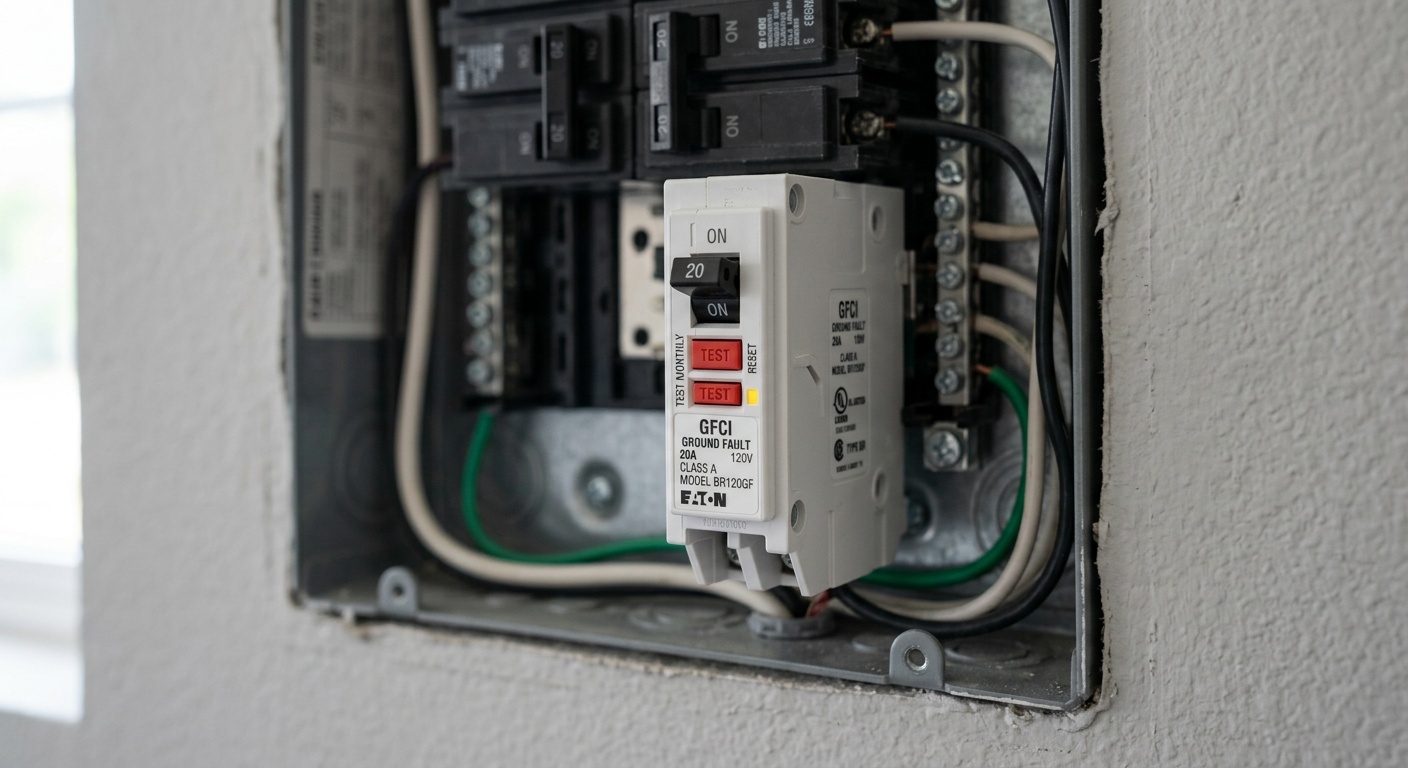
Solution: Use a simple outlet tester (available for under $15 at any hardware store) with a GFCI test function. Press the test button — if the outlet loses power and requires a reset, it’s GFCI protected. Alternatively, examine your panel: GFCI breakers have a distinctive TEST button on their face, distinct from standard breakers.
Challenge 3: Deciding Between GFCI Outlets vs. GFCI Breakers
Homeowners upgrading older circuits sometimes wonder whether to install individual GFCI outlets or replace the entire circuit’s breaker with a GFCI breaker. Each approach has merit.
GFCI outlets cost less per installation, allow easy testing and reset at the point of use, and can protect downstream outlets on the same circuit. GFCI breakers protect the entire circuit from the panel, are ideal when multiple outlets need coverage, and eliminate the need for multiple GFCI outlets in a single room. For most retrofit scenarios in 2026, installing a GFCI outlet at the first outlet in a bathroom or kitchen circuit and labeling downstream outlets as “GFCI Protected” offers the most cost-effective solution.
Protection Coverage by Home Area
The chart below illustrates the percentage of home areas in a typical 2026 residence that require GFCI protection under the current NEC, versus those primarily protected by circuit breakers alone:
Green bars = GFCI protection required. Orange = AFCI/standard circuit breaker primary protection. Based on 2023 NEC requirements as adopted in 2026.
Frequently Asked Questions
Can a GFCI outlet replace a circuit breaker entirely?
No — and this is a critical misconception to clear up. GFCI outlets and circuit breakers protect against fundamentally different hazards and cannot substitute for one another. A GFCI outlet monitors for tiny current imbalances (ground faults) that endanger human life, but it will not trip when a circuit is overloaded or short-circuited. If you removed your circuit breaker and relied solely on GFCI outlets, your wiring could overheat and ignite during an overload event while the GFCI remains completely unresponsive. Both layers of protection are legally required and functionally essential.
How often should I test my GFCI outlets and circuit breakers?
The CPSC and most electrical safety organizations recommend testing GFCI outlets monthly using the built-in TEST and RESET buttons. A properly functioning GFCI should cut power when you press TEST and restore it when you press RESET. If either function fails, replace the outlet immediately. Circuit breakers should be manually tested (by switching them fully off and back on) annually to prevent the contacts from sticking in the “on” position — a condition that can develop in breakers that haven’t been cycled for years. Some electricians recommend professional panel inspection every 5–10 years for homes over 20 years old.
Does a “tripped” circuit breaker always mean I have an electrical problem?
Not necessarily — but you should never dismiss a tripped breaker without investigating. Occasional trips on circuits with multiple high-draw appliances are simply the breaker doing its job, and adding a dedicated circuit resolves the issue permanently. However, a breaker that trips repeatedly without an obvious overload cause, one that trips immediately upon reset, or one that feels warm to the touch may indicate damaged wiring, a failing appliance, or a deteriorating breaker that needs replacement. In 2026, smart circuit breakers from brands like Leviton and Siemens can log trip events with timestamps, helping homeowners and electricians diagnose patterns before they become serious problems.
Your Home Electrical Safety Action Plan
Here’s the straight talk: most electrical tragedies in homes aren’t caused by ignorance about circuit breakers versus GFCI outlets in theory — they’re caused by the gap between knowing and doing. The information above is only valuable when it translates into action.
As smart home technology continues integrating with electrical infrastructure in 2026 — with AI-assisted load management, whole-home energy monitoring, and wireless smart breakers becoming mainstream — the foundational safety principles around ground faults and overcurrent protection remain as critical as ever. Technology layers on top of these principles; it doesn’t replace them.
Here are your five immediate next steps:
- Walk every wet area of your home this week. Check each bathroom, kitchen, laundry area, garage, and exterior outlet. Press the TEST button on any outlet with TEST/RESET buttons. If it doesn’t cut power — replace it.
- Purchase an outlet tester. A $12–$15 investment from any hardware store tells you instantly whether outlets are wired correctly and whether GFCI protection is active. Test every outlet in wet locations.
- Open your electrical panel and look for AFCI breakers. If your home was built before 2000 and has never had panel work, most breakers are likely standard — no arc-fault protection. Discuss AFCI upgrades with a licensed electrician, particularly for bedroom circuits.
- Schedule a professional inspection if your home is over 20 years old. Aging wiring insulation, corroded connections, and outdated panels (particularly Federal Pacific and Zinsco panels from the 1970s–1990s) represent serious risks that require expert evaluation.
- Replace GFCI outlets older than 15 years. Internal components degrade over time. An outlet that appears to work fine may have a compromised sensing circuit. When in doubt, replace — the cost is minimal and the protection is invaluable.
“The best electrical safety system is the one you’ve actually verified is working — not the one you assume is working.”
Circuit breakers and GFCI outlets aren’t competing technologies — they’re complementary guardians operating on completely different threat planes. One watches the quantity of current; the other watches its quality and path. Together, they form a protection system greater than the sum of its parts.
So here’s the question worth sitting with: When did you last actually test the safety devices that stand between your family and a preventable electrical emergency? If you can’t answer that with confidence, today is the right day to find out.