Understanding Your Home Electrical Panel and Circuit Breakers: The Complete Homeowner’s Guide
Reading time: 14 minutes
That mysterious gray metal box in your basement, garage, or utility closet? Most homeowners walk past it every single day without a second thought — until the lights go out. Then it becomes the most important object in the house. Your electrical panel is the central nervous system of your home, and understanding how it works isn’t just useful — it could one day save your life.
Here’s the straight talk: You don’t need to be an electrician to understand your electrical panel. You just need the right framework, the right vocabulary, and the confidence to know when to act yourself and when to call a professional. This guide gives you all three.
Quick Scenario: Imagine it’s a Wednesday evening in 2026. You’re hosting a dinner party, every appliance is running, and suddenly — darkness. Half your home goes dark. Do you know what to do next? By the end of this article, you absolutely will.
Table of Contents
- What Is a Home Electrical Panel?
- Anatomy of Your Panel: Key Components Explained
- Circuit Breakers: The Unsung Heroes of Home Safety
- 3 Common Electrical Panel Problems (And How to Handle Them)
- Electrical Panels in 2026: Modern Homes, Modern Demands
- When to Upgrade Your Panel: A Practical Decision Guide
- Safety Tips Every Homeowner Should Know
- Frequently Asked Questions
- Your Electrical Empowerment Roadmap
What Is a Home Electrical Panel?
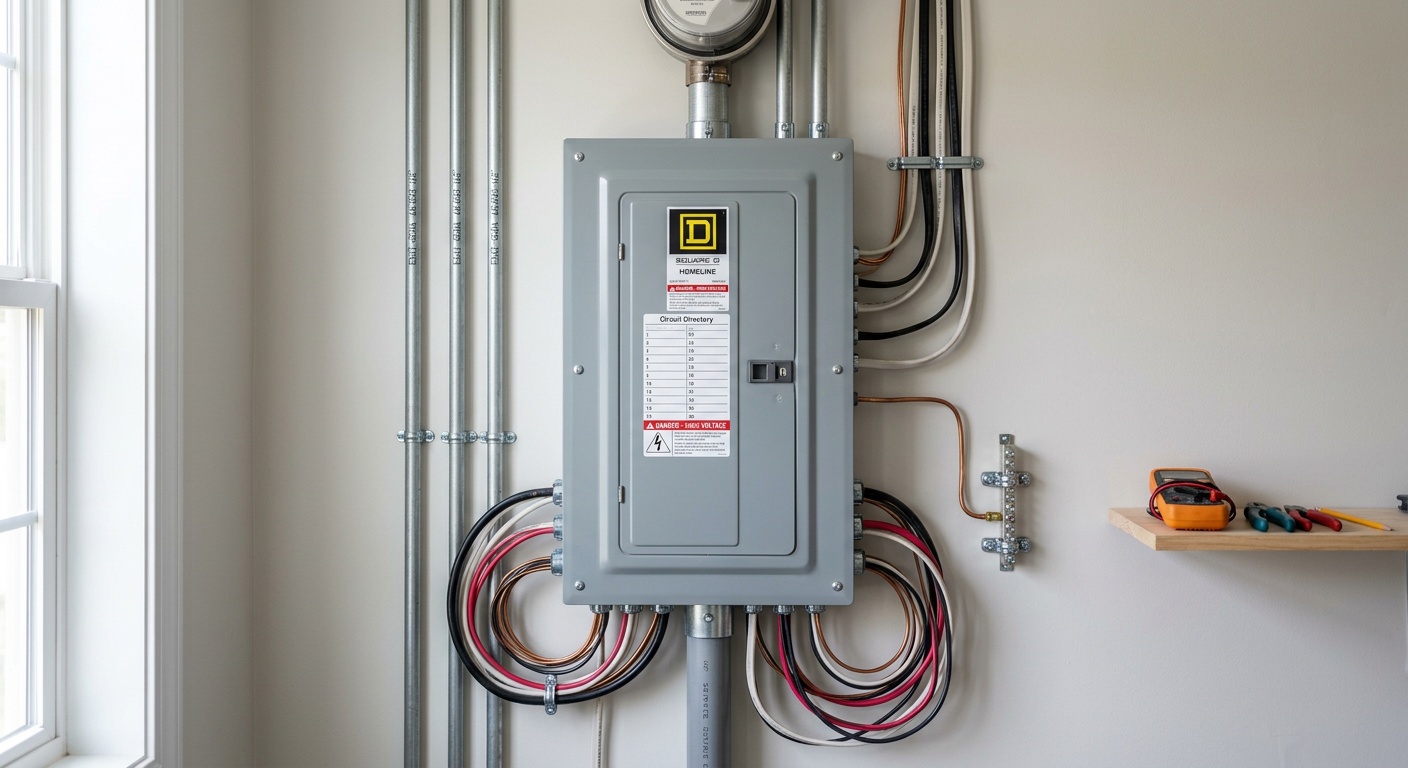
Your home electrical panel — also called a breaker box, load center, or distribution board — is the central hub that receives electricity from your utility company and distributes it throughout your home via individual circuits. Think of it as an airport control tower: all flights (electrical currents) are managed from a single point to ensure safe, organized traffic flow.
In the United States, the average home in 2026 operates on a 200-amp service panel, which is considered the modern standard for homes with typical appliances, EV chargers, and smart home technology. Older homes built before 1990, however, may still be running on 100-amp or even 60-amp panels — a potential safety and capacity concern we’ll explore later.
The panel receives power from two 120-volt service wires from the utility company. Together, these create a 240-volt system, which powers large appliances like your dryer, HVAC system, and electric oven, while individual 120-volt circuits serve lighting, outlets, and smaller devices.
“The electrical panel is probably the single most safety-critical component in any residential structure. It’s the first line of defense against overloads, short circuits, and electrical fires.” — National Electrical Safety Foundation, 2025 Annual Report
According to the U.S. Fire Administration’s 2025 data, approximately 46,700 home electrical fires occur annually in the United States, resulting in over $1.4 billion in property damage. A significant portion of these are directly linked to outdated panels, faulty breakers, or improper DIY electrical work. Understanding your panel is, quite literally, a matter of safety.
Anatomy of Your Panel: Key Components Explained
Opening your electrical panel for the first time can feel intimidating. Let’s demystify every component so you know exactly what you’re looking at.
The Main Breaker
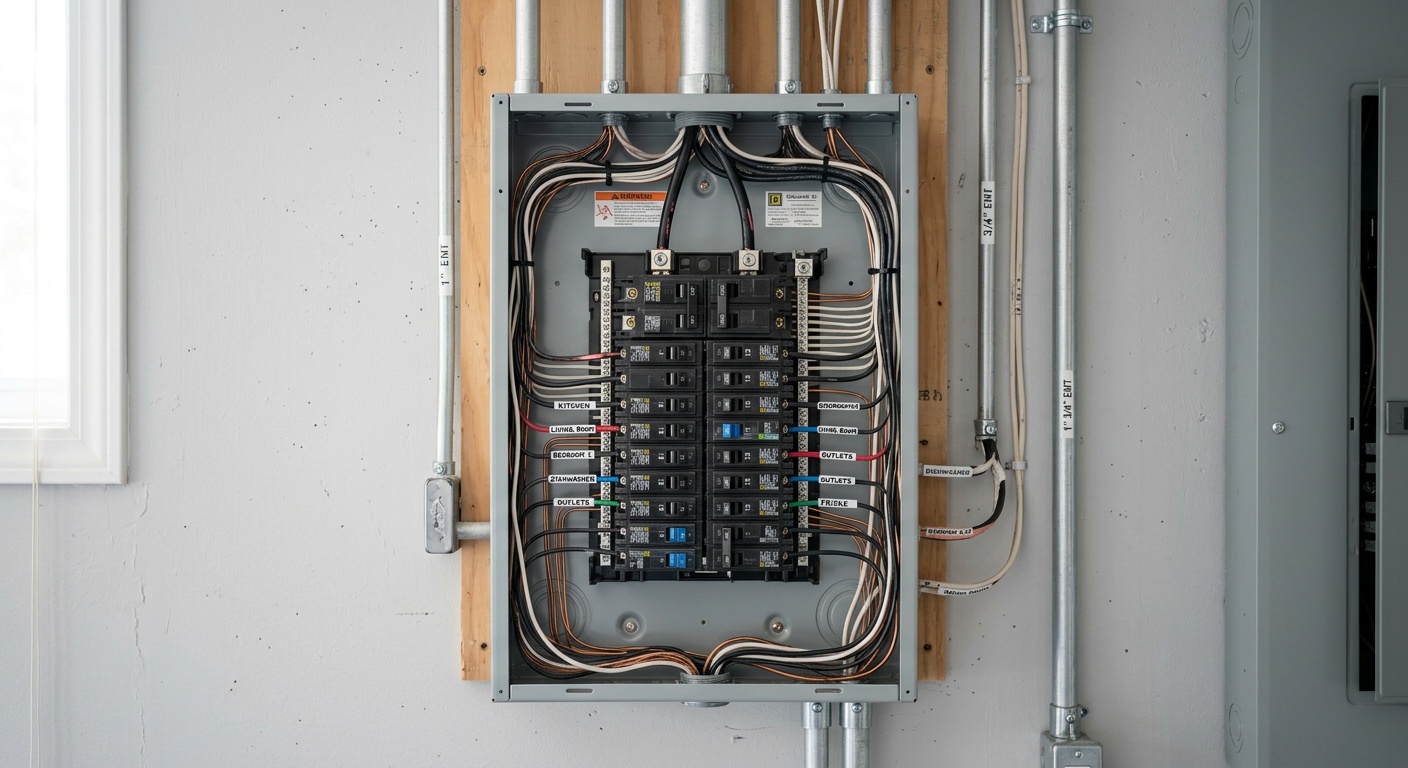
Located at the top of your panel, the main breaker is the master switch for your entire home. It controls all power flowing into the panel and is typically rated at 100, 150, or 200 amps. Flipping this breaker cuts power to every circuit in the house simultaneously. This is the switch you’d use in a genuine emergency — or when a major repair requires total power shutdown.
One critical point: the main breaker does not cut power to the service wires entering from the utility company. Those lines are always live. This is why working above the main breaker is strictly a utility company responsibility — never attempt it yourself.
Hot Bus Bars
Running vertically down both sides of your panel are two metal hot bus bars, each carrying 120 volts. Individual circuit breakers clip onto these bars to receive power. Single-pole breakers connect to one bar (120V), while double-pole breakers straddle both bars (240V). The symmetrical layout you see in most modern panels isn’t aesthetic — it’s engineered for balanced load distribution across both legs of your service.
Neutral and Ground Bars
On the sides of the panel, you’ll see rows of terminal screws with white and bare copper (or green) wires attached. These are the neutral bar and ground bar. In the main panel, these bars are typically bonded together. In a subpanel (a secondary panel fed from the main), they must be kept separate — an important distinction that confuses many DIY installers.
Individual Circuit Breakers
Each switch-like device in your panel controls a single circuit. They’re labeled (or should be) to identify which area of the home they serve: “Kitchen Outlets,” “Master Bedroom,” “HVAC,” and so on. We’ll explore these in much more detail in the next section.
The Panel Directory
This is the paper chart on the inside of your panel door. If yours is blank, outdated, or illegible — a shockingly common situation in homes older than 15 years — one of your first priorities should be circuit mapping: methodically identifying and labeling every breaker. It takes about two hours and requires a helper to flip breakers while you check which outlets and fixtures lose power. The payoff is enormous peace of mind.
Circuit Breakers: The Unsung Heroes of Home Safety
If the panel is your home’s control tower, circuit breakers are the air traffic controllers — constantly monitoring, always ready to act. A circuit breaker is an automatic safety switch that interrupts electrical flow when a circuit experiences more current than it’s designed to handle.
How Circuit Breakers Actually Work
Inside every circuit breaker is a bimetallic strip — two metals bonded together that expand at different rates when heated. When current flows through the breaker within normal limits, the strip maintains its shape and the circuit stays closed. When current exceeds the breaker’s rated capacity, the strip heats and bends, triggering a mechanical switch that opens the circuit and stops current flow.
For faster-acting protection against short circuits (which create massive current spikes in milliseconds), breakers also contain an electromagnetic mechanism: a solenoid that responds instantaneously to sudden surges, tripping the breaker far faster than the thermal strip could react.
This dual-action protection is elegant engineering — thermal response handles gradual overloads, electromagnetic response handles sudden faults. Together, they provide comprehensive protection across a wide range of electrical fault scenarios.
Types of Circuit Breakers You Should Know
Not all breakers are equal. Modern electrical codes — including the 2023 National Electrical Code (NEC), still widely adopted and enforced in 2026 — require specific breaker types in certain locations. Here’s what you need to know:
- Standard Single-Pole Breakers: 15A or 20A, controlling 120V circuits for general lighting and outlets
- Standard Double-Pole Breakers: 240V circuits for dryers, ranges, water heaters, and EV chargers
- GFCI Breakers (Ground Fault Circuit Interrupter): Required near water sources; detect ground faults in milliseconds and trip to prevent electrocution
- AFCI Breakers (Arc Fault Circuit Interrupter): Detect dangerous electrical arcing caused by damaged wiring; now required in bedrooms, living rooms, and most habitable spaces under the 2023 NEC
- Dual-Function AFCI/GFCI Breakers: Combine both protections; increasingly common in 2026 home renovations and new construction
- Smart Breakers: A growing category in 2026, these WiFi-connected breakers allow remote monitoring and control via smartphone apps
Pro Tip: If your home was built before 2000 and hasn’t had electrical updates, it almost certainly lacks AFCI protection. This alone is worth a conversation with a licensed electrician — arc faults are a leading cause of residential electrical fires.
3 Common Electrical Panel Problems (And How to Handle Them)
Let’s move from theory to practice. Here are the three most frequent panel-related issues homeowners encounter, along with honest guidance on what you can handle yourself and what requires a professional.
Problem 1: A Tripped Breaker
What it looks like: A breaker that’s moved to a middle position between ON and OFF, or one that feels looser than the others when you press it.
What causes it: Overloaded circuit (too many devices drawing power simultaneously), a short circuit, or a ground fault. Most tripped breakers are caused by simple overloads — plugging too many high-draw devices into one circuit.
What to do:
- Identify which circuit tripped by checking the panel directory
- Unplug high-wattage devices from that circuit before resetting
- Push the breaker firmly to the OFF position first, then back to ON
- If it trips again immediately, you likely have a short circuit or ground fault — stop resetting and call an electrician
- If it holds but trips again under load, you have an overloaded circuit that needs redistribution or a dedicated circuit
Case Study: A homeowner in Phoenix, Arizona contacted an electrician in early 2026 after their kitchen breaker tripped repeatedly each morning. The culprit? A 15-amp circuit serving a microwave (1,200W), a coffee maker (1,000W), and a toaster oven (1,500W) — all running simultaneously during the breakfast rush. Total draw: 3,700 watts on a 15-amp circuit designed for 1,800 watts. The solution was a dedicated 20-amp circuit for the microwave, costing $285 installed. No more morning darkness.
Problem 2: A Breaker That Won’t Reset or Stay On
What it looks like: You reset the breaker, but it trips again immediately or won’t click into the ON position at all.
What causes it: A hard fault in the wiring (short circuit or ground fault), a failed breaker, or an issue with a connected appliance.
What to do: First, unplug everything on that circuit and try resetting. If it holds, add devices back one by one until you find the culprit. If it still won’t reset with nothing connected, the breaker itself may be faulty — a legitimate reason to call an electrician. Do not attempt to bypass a breaker or hold it in the ON position.
Problem 3: Burning Smell or Visible Damage Inside the Panel
What it looks like: Scorch marks, melted plastic, burning smell, or discoloration on or around breakers, wires, or the bus bar.
What to do: This is a genuine emergency. Do not attempt to investigate or repair this yourself. Turn off the main breaker if you can do so safely and immediately call a licensed electrician. Electrical arcing inside a panel can ignite surrounding materials within minutes. This is not a situation for hesitation or DIY troubleshooting.
Electrical Panels in 2026: Modern Homes, Modern Demands
The electrical demands of a typical home have transformed dramatically over the past decade, and 2026 represents a genuine inflection point in residential power consumption. Consider what a mid-range home now regularly operates: smart home hubs, multiple EV charging stations, heat pump HVAC systems, induction ranges, whole-home battery backup systems, solar inverters, and a proliferation of high-draw electronics. The average U.S. household electrical consumption has increased by approximately 23% since 2019, according to the U.S. Energy Information Administration’s 2025 Residential Energy Consumption Survey.
This demand surge has made 200-amp panels the practical minimum for most modern homes, and is driving a growing market for 320-amp and 400-amp service upgrades in homes with EV charging and whole-home electrification. In California, where EV adoption is highest in the nation (with EVs representing 42% of new car sales in 2025), many electricians report that panel upgrade requests have doubled since 2023.
A particularly exciting development in 2026 is the rise of the smart electrical panel. Companies like Span, Leviton, and Siemens are now offering app-connected panels that provide real-time circuit-by-circuit energy monitoring, remote circuit control, and intelligent load management — automatically prioritizing power to essential circuits during grid events or when running on battery backup. These panels, while priced at $3,000–$5,000 installed (compared to $1,500–$2,500 for a conventional upgrade), represent a genuine quality-of-life and efficiency leap for tech-savvy homeowners.
When to Upgrade Your Panel: A Practical Decision Guide
Panel upgrades represent a significant investment — typically ranging from $1,500 to $4,500 in 2026, depending on your location, current service size, and the complexity of the upgrade. Here’s how to think about whether you need one.
Clear Signs You Need a Panel Upgrade
- Your panel is 60 or 100 amps and you have a modern home with central AC, multiple large appliances, or want to add EV charging
- You have a Federal Pacific Electric (FPE) Stab-Lok or Zinsco/Sylvania panel — both have documented safety defects and should be replaced regardless of age
- Your breakers trip frequently even when usage seems normal
- You’re planning a significant renovation or addition that will add circuits
- You want to install a home EV charger (typically requiring a dedicated 240V, 50-amp or 60-amp circuit)
- Your panel has fuses instead of breakers — this indicates a panel likely 50+ years old
- You notice flickering lights, especially when large appliances cycle on
Comparative Panel Capacity Table:
| Panel Size | Typical Home Fit | EV Charging | 2026 Upgrade Cost | Recommended? |
|---|---|---|---|---|
| 60-Amp | Homes built pre-1970, small footprint | Not feasible | Upgrade essential | ❌ Upgrade immediately |
| 100-Amp | Smaller homes, minimal large appliances | Level 1 only (slow) | $1,500–$2,200 | ⚠️ Upgrade if expanding |
| 150-Amp | Mid-size homes, moderate appliance load | Level 2 possible | $1,800–$2,800 | ✅ Adequate for most |
| 200-Amp | Modern standard, most homes 1990–present | Full Level 2 support | $2,200–$3,500 | ✅ Recommended standard |
| 320–400-Amp | Large homes, solar + battery, multiple EVs | Multiple EVs + fast charging | $3,500–$6,000+ | ✅ Future-proof choice |
Data Visualization: Common Reasons Homeowners Upgrade Panels in 2026
Adding EV Charging
Home Renovation / Addition
Outdated/Unsafe Existing Panel
Solar + Battery Backup Installation
Frequent Breaker Trips / Capacity Issues
Source: HomeAdvisor Electrical Trends Survey, 2025 (respondents could select multiple reasons)
Safety Tips Every Homeowner Should Know
Knowledge without action is just trivia. Here are practical safety practices you can implement starting today:
Panel Safety Fundamentals
- Label every breaker accurately. An unlabeled panel is a safety hazard. Spend two hours this weekend doing a proper circuit map.
- Never overload a breaker. If you regularly have extension cords running throughout a room, that’s a sign you need more outlets — not more cords.
- Keep the area in front of your panel clear. The NEC requires 36 inches of clear working space in front of all panels. This isn’t optional — it’s a fire code requirement.
- Know where your panel is and make sure every household member old enough to understand does too. In an emergency, seconds matter.
- Test GFCI outlets and breakers monthly. Press the TEST button — the outlet or connected devices should lose power. Press RESET to restore. If it doesn’t respond correctly, replace it.
- Schedule a professional inspection every 10 years — or immediately if you notice burning smells, flickering lights, warm panel covers, or frequent tripping.
- Never use a panel with the cover removed except during a licensed electrician’s visit. The exposed bus bars carry lethal voltage even when the main breaker is off.
Pro Tip: Take a photo of your panel directory (the label inside the door) and save it to your phone. You’ll thank yourself the next time you’re troubleshooting in the dark — literally.
Case Study — The Importance of Regular Inspection: A homeowner in suburban Atlanta discovered in 2025 that her 1998-era panel had multiple double-tapped breakers — a practice where two wires are connected to a single breaker terminal not designed for it. This is a code violation and a fire risk. The defect was caught during a home inspection ahead of refinancing. The repair cost $650. Had a fire occurred, estimated damages would have been well over $80,000. Regular professional inspection isn’t paranoia — it’s prudent financial and personal protection.
Frequently Asked Questions
Can I replace a circuit breaker myself?
Technically, replacing an individual circuit breaker is within the capability of a knowledgeable DIYer — but it carries significant risk and is not recommended without electrical experience. Even with the main breaker off, the service entrance wires above the main breaker remain energized at lethal voltage. Additionally, in most jurisdictions, electrical work beyond basic fixture replacement requires permits and must be performed by a licensed electrician. If you’re replacing a standard breaker because it’s faulty, the safest and most code-compliant approach is to hire a licensed electrician. The work typically costs $150–$300 and takes under an hour.
Why does my breaker keep tripping even though I’m not running many appliances?
Repeated tripping with seemingly normal usage can indicate several issues: the circuit may be underrated for the appliances connected (a 15-amp circuit serving a modern refrigerator, microwave, and coffee maker will struggle), the breaker itself may be failing and becoming overly sensitive, or there may be a wiring fault such as a loose connection or damaged insulation causing intermittent shorts. A single tripping incident is usually a simple overload. Repeated tripping on the same circuit — especially when you’ve reduced the load — warrants a professional evaluation. Don’t ignore it or habitually reset without investigation; it’s your electrical system telling you something is wrong.
How do I know if my electrical panel is dangerous and needs immediate replacement?
There are several red flags that indicate your panel poses a safety risk requiring urgent attention. If your panel is a Federal Pacific Electric (FPE) Stab-Lok or a Zinsco/Sylvania panel, replace it regardless of apparent condition — both brands have been found to have breakers that fail to trip under fault conditions, creating serious fire risk. Additional warning signs include: scorch marks or melted plastic inside the panel, a burning or electrical smell near the panel, breakers that feel warm to the touch, a panel that uses fuses rather than breakers, or a panel with physically corroded or damaged components. Any of these warrants an immediate call to a licensed electrician — not next month, but this week.
Your Electrical Empowerment Roadmap: Next Steps That Actually Matter
You’ve come a long way from that mysterious gray box. Now let’s turn understanding into action. Here’s your practical, prioritized roadmap:
- This weekend — Map and label your panel. Grab a helper, a flashlight, and a notepad. Systematically identify every circuit and create an accurate, legible directory. This single action creates an enormous safety foundation and will save you time and stress for years.
- Within the next 30 days — Assess your panel’s age and type. Look for the manufacturer name and model. Google it if necessary. If you have an FPE Stab-Lok or Zinsco panel, schedule an electrician consultation immediately. If your panel is 100 amps or less and you have modern appliances or plan EV charging, start budgeting for an upgrade.
- This month — Test all GFCI outlets and GFCI/AFCI breakers. Walk every bathroom, kitchen, garage, and outdoor outlet. Press TEST. Confirm it cuts power. Press RESET. Confirm it restores power. Replace any that don’t function correctly.
- Within six months — Schedule a professional panel inspection if your home is more than 15 years old and hasn’t had electrical work recently. Many electricians offer basic panel assessments for $150–$250. Consider it cheap peace of mind insurance.
- Looking ahead to 2027 — Future-proof your electrical infrastructure. If you’re considering solar panels, a home battery system, or an EV charger within the next two years, plan your panel upgrade now. Utility companies in many states are facing longer interconnection timelines, and electrical contractor availability continues to be tight in growing metro areas. Early planning equals significant time and cost savings.
As homes continue to electrify — from transportation to heating to cooking — the role of your electrical panel will only grow in importance. The homes of 2030 will demand robust, intelligent, and expandable electrical infrastructure. What you do with your panel today directly shapes your home’s capability and safety for the next decade.
Here’s the question worth sitting with: When was the last time you actually opened your electrical panel and looked inside? If the honest answer is “never” — consider this your invitation to change that, starting today.